Best RO Systems
HomeGuidesDoes RO remove minerals?
Water quality

Does reverse osmosis remove minerals? What that actually means

We're reader-supported: buying through our links may earn us a commission at no extra cost to you. We compare published specifications, certifications and prices — we don't run a testing lab.

Water pouring into a clear drinking glass on a pale stone countertop, with small mineral pebbles scattered around the base

Ask this in two different places and you get two confident, opposite answers. In one corner, reverse osmosis produces dead water that leaches minerals out of your body. In the other, the minerals in tap water are nutritionally irrelevant and nobody should spend a second on them. Both camps usually have something to sell.

The factual part is short and undisputed: yes, RO removes most of the dissolved minerals from your water along with the dissolved contaminants, because the membrane cannot tell them apart. Everything worth discussing happens after that sentence.

One thing plainly, up front: everything here that touches on health is general consumer information, not medical advice. We don't know your water, your diet or your history, and if you have a specific medical reason to care about mineral intake — a kidney condition, a prescribed diet, an infant on formula — that's a conversation with your doctor, not with a buying guide.

How the membrane decides what stays and what goes

An RO membrane is a semi-permeable film with pores in the neighborhood of 0.0001 micron — both iSpring and Bluevua publish that figure. Household pressure pushes water against it. Water molecules pass. Almost everything dissolved in the water does not, because it is either too large for the pore or carries an electrical charge the membrane rejects, and the rejected fraction goes down the drain.

Here is the part that answers the question. “Dissolved solids” is not a category of bad things; it is a category of things dissolved in water. Calcium, magnesium, sodium, potassium, bicarbonate and sulfate are dissolved solids. So are lead, arsenic, fluoride, nitrate and chromium. A membrane that rejects one rejects the other, and manufacturers are candid about it if you read past the headline. Waterdrop's own description of the G3P600 lists what it reduces in one breath — TDS, chromium, PFAS, radium, fluoride, arsenic salt, iron, calcium, chloride, chlorine — with calcium sitting between iron and chloride. That isn't sloppy copywriting; it's the mechanism described accurately. The property that removes lead and PFAS is the property that removes calcium and magnesium.

So, unambiguously: there is no membrane that keeps the good ones and rejects the bad ones. Selectivity by size and charge does not map onto selectivity by virtue. Every system marketed as mineral RO or alkaline RO strips the water first and adds minerals back afterwards, in a separate stage downstream of the membrane. That turns a confusing category into a plain hardware question: do you want the extra stage, and what does it cost? Every number below comes from a specification sheet or is arithmetic we show our work for.

What that does — and doesn't — actually mean

Drinking water is a minor contributor to mineral intake for most people eating an ordinary diet. Calcium comes overwhelmingly from dairy, greens, legumes and fortified foods; magnesium from nuts, seeds, whole grains and greens. Water contributes something, and more than nothing in hard-water regions, but it is small next to a plate of food. Scale is exactly what both sides of this argument leave out.

We're deliberately not handing you a percentage, because the honest answer depends on two things only you know: how mineralized your supply is, and what you eat. A household on a soft municipal supply loses little to the membrane, because there was little there. A household on a hard well loses a lot — and that same hardness has been scaling the kettle and spotting the glasses. Any guide quoting one confident number for how much calcium RO costs you per day has invented it.

Two things follow. The framing that survives scrutiny is taste and preference first, nutrition second: almost nobody adds a mineral stage because of a blood test, they add it because the water tastes like nothing. And don't let anyone, us included, sell you certainty in either direction. It is not established that mineral-free drinking water harms a well-fed adult, nor that mineral content in water is meaningless for everyone. What is established is that the stage costs about thirty dollars and is reversible.

Why RO water tastes flat, and why that's the real reason people add minerals

This is the complaint that genuinely shows up after an install, and it isn't imaginary. What you taste in water is mostly what's dissolved in it: bicarbonate gives water body, calcium and magnesium add a mineral edge, sulfate reads as crisp or in quantity slightly bitter. Take a supply running at 250 ppm of dissolved solids and drop it into the low double digits — iSpring publishes 93% to 98% TDS reduction for the RCC7AK-BN, and up to 97% for its 75 GPD membranes under NSF/ANSI 58 test conditions — and you haven't only removed the chlorine and the metals. You've removed most of the flavor. Low TDS carries less taste, and that is the whole explanation.

People describe the result as flat, empty, or like drinking nothing. That last one is sometimes a compliment: coming off a heavily chlorinated supply, or a well with a sulfur note, like nothing is exactly the upgrade you paid for. Coming off a decent, moderately hard supply you were quietly fond of, it's a loss — and you notice it in tea, in coffee, and in a glass of cold water at two in the morning. This, not nutrition, is why most mineral cartridges get bought.

One caveat before you judge: fresh carbon sheds fines and a taste of its own for the first few gallons, so do the flush your installation manual asks for and give it two days.

The theme that repeats across owner reviews of remineralization cartridges: the water was obviously cleaner and obviously less interesting, and the people who added a mineral stage decided within the first month or never bothered at all.

pH, alkaline water, and where the specification sheet stops

RO water tends to be slightly acidic, and iSpring says so in its own documentation rather than leaving you to discover it: a standard 5-stage RO system produces slightly acidic water with a pH of 7.0 or below. The bicarbonate that buffers your tap water is a dissolved solid, so the membrane takes it out; dissolved carbon dioxide, being a gas, passes straight through and forms a little carbonic acid with nothing left to neutralize it.

An alkaline cartridge is mechanically unglamorous, which is a point in its favor. It's a small housing packed with mineral media — calcite, mineral stone or ceramic granules. Purified water runs through the bed on its way to the faucet and dissolves a small, self-limiting quantity of it; mineral content goes up and pH follows. Waterdrop, iSpring, APEC and Frizzlife each describe theirs as restoring calcium and magnesium, with sodium, potassium or zinc depending on the media. Two consequences: the bed dissolves, so it is consumed, which is why these cartridges carry a service life in months and gallons rather than years. And the effect is bounded — you're dissolving a trace of mineral into water, not reconstituting a mountain spring.

Which brings us to the part we won't repeat as fact. Waterdrop's listing for the MNR35 states that drinking its mineral water will, in the long run, help avoid chronic diseases, slow the aging process and improve digestion and immunity. That's manufacturer copy, we have no way to verify it, and we're not going to launder it into an editorial claim. What is checkable is the boring half: the cartridge costs $29.99, is rated for 9 to 12 months or 1,100 gallons, and fits 1/4-inch and 3/8-inch tubing. Buy it for taste and a measurable pH shift; anything past that is marketing, not specification.

The three ways to put minerals back

There are exactly three routes, and which one is right depends mostly on whether you already own a system.

Route one: bolt a cartridge onto the system you already have

The cheapest and least committal option. An inline remineralization cartridge sits in the tubing between your system's last stage and the faucet, and it doesn't care what brand is upstream of it.

01Retrofit

Waterdrop MNR35 remineralization filter

For a system you already own
9–12 months or 1,100 gallons · fits 1/4-inch & 3/8-inch quick-connect · inline · adds calcium, magnesium, sodium, potassium

This is the hardware that makes the whole mineral debate low-stakes. Because it's built for 1/4-inch and 3/8-inch quick-connect tubing — what essentially every under-sink RO system sold in the US uses — it retrofits to almost anything, with no brand matching and no adapter hunt. Waterdrop rates it for 9 to 12 months or 1,100 gallons and suggests changing at nine. Two caveats: the manufacturer says not to connect it to a hot-water line, and an inline stage adds two push-fit joints under your sink. Check both with a dry paper towel an hour after fitting, and again next morning.

If you know you're keeping the system for years, the two-pack — Waterdrop MNR35-2, $55.99 — is the same filter in a longer supply.
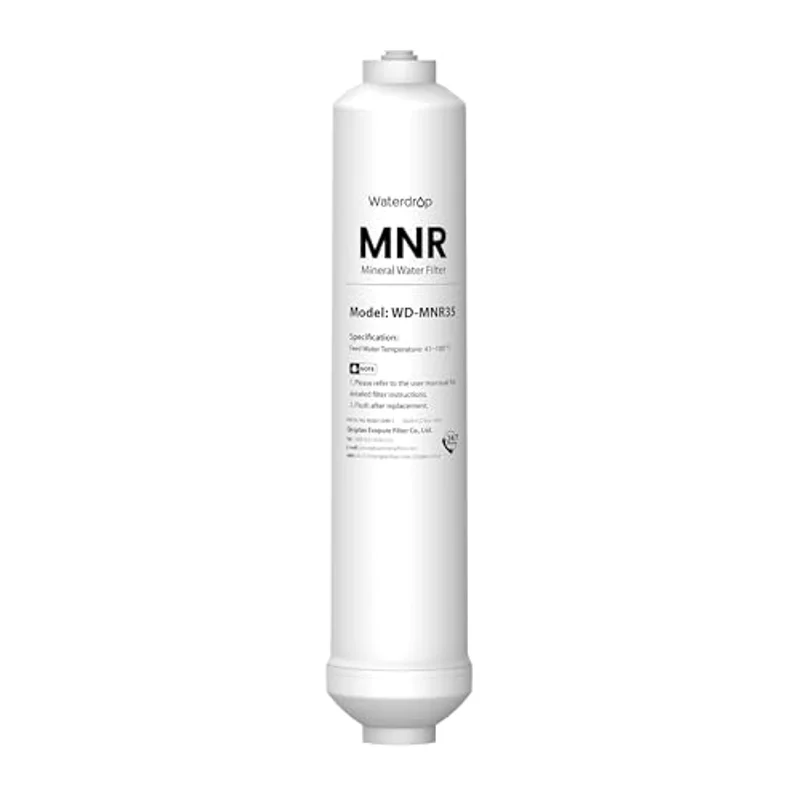
Waterdrop MNR35 inline remineralization filter cartridge for reverse osmosis systems
$29.99
Inline cartridgeCheck price →

Route two: buy a system that already includes the stage

One note on certification before you compare these three, because the labels are not interchangeable and the industry blurs them constantly. NSF/ANSI 58 certifies that a system reduces contaminants and dissolved solids as claimed. NSF/ANSI 372 certifies only that the materials are lead-free. WQA is a different certifying body — a real one, but not the same claim as NSF/ANSI 58.

02Certified

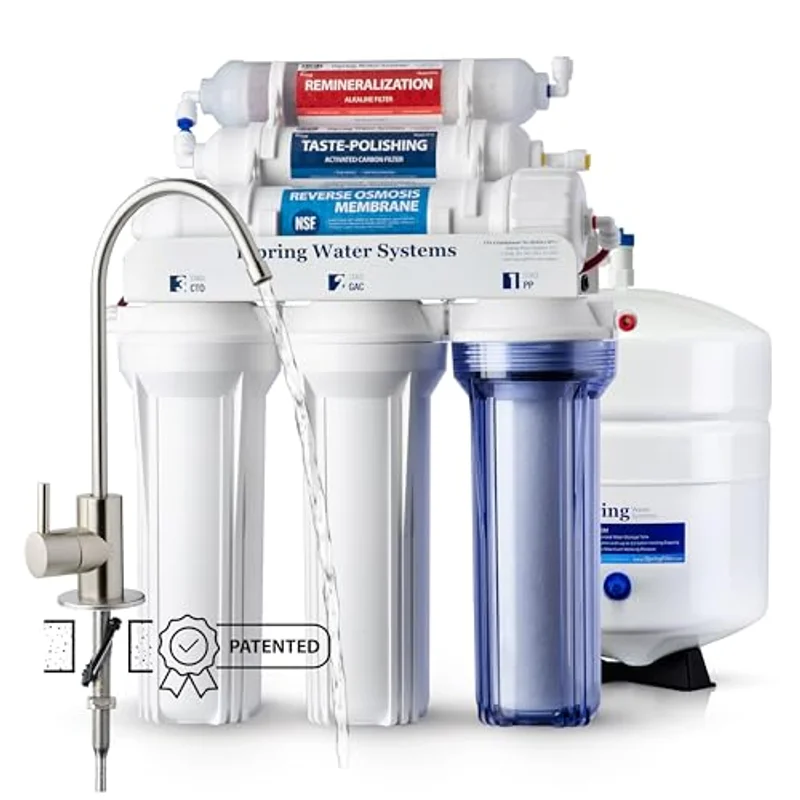
iSpring RCC7AK-BN

The strongest certification claim with a mineral stage in the box
NSF/ANSI 58, whole system · 75 GPD · 6 stages · natural mineral AK stage · tank

iSpring certifies the RCC7AK as a complete system to NSF/ANSI 58 rather than certifying a component or the materials, which is the distinction worth paying for. Published reductions are 93% to 98% for TDS and 96% to 99% for PFAS, and the sixth stage is the natural mineral AK cartridge that returns calcium and magnesium after the membrane. The first housing is transparent, so you can watch the sediment load build, and the faucet uses a top-mounted fastener, so you tighten it from the countertop. The trade-off is footprint: three housings plus a pressure tank wants most of a cabinet.

The theme that repeats across owner reviews: the install takes an afternoon, and the standard-size cartridges keep it cheap to live with afterwards.

iSpring RCC7AK-BN 6-stage alkaline reverse osmosis system with mineral stage
$198.76
6-stage · alkalineCheck price →
03Serviceable

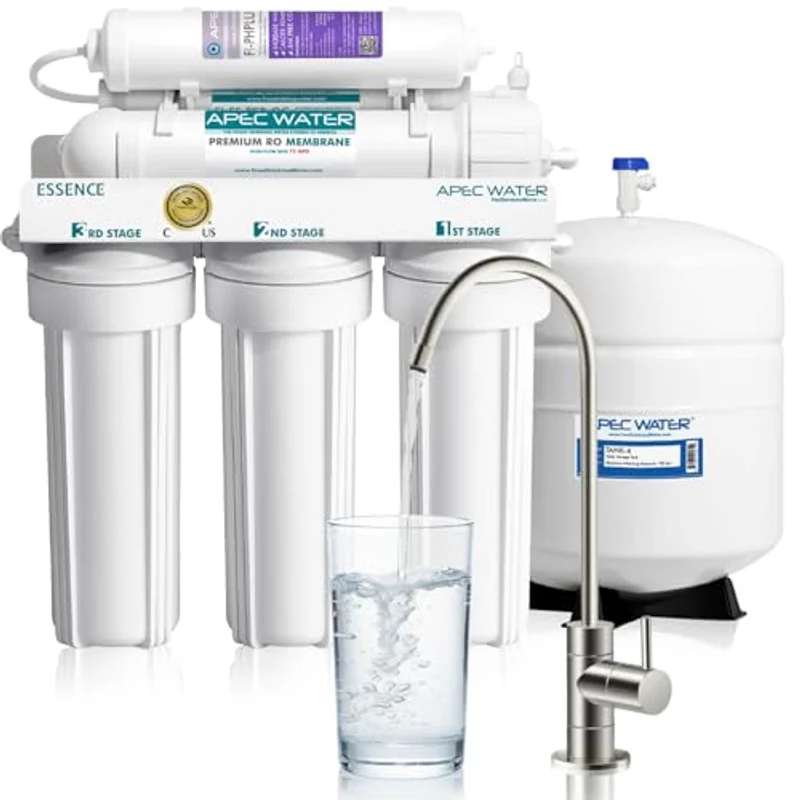
APEC Water ROES-PH75

Standard parts and a calcium stage
WQA certified · 75 GPD · 6 stages · calcium remineralization · 40–85 psi feed · max 2,000 ppm TDS

APEC's Essence line is the one recommended by people who service these things rather than sell them: heavy housings, long-life cartridges, everything in standard 10-inch sizes so you're never hostage to one brand's part numbers. The sixth stage uses premium-grade calcium for pH enhancement — a narrower and more honest claim than most of this category makes. Be precise about the label: this is WQA-certified, not NSF/ANSI 58. Check two specifications against your house first: it wants feed pressure between 40 and 85 psi, and it's rated for incoming water up to 2,000 ppm TDS.

The theme that repeats across owner reviews: it is quiet, it keeps working, and replacement parts are still easy to find years after purchase.

APEC Water ROES-PH75 6-stage alkaline reverse osmosis system with calcium remineralization
$239.99
6-stage · alkalineCheck price →
04No tank

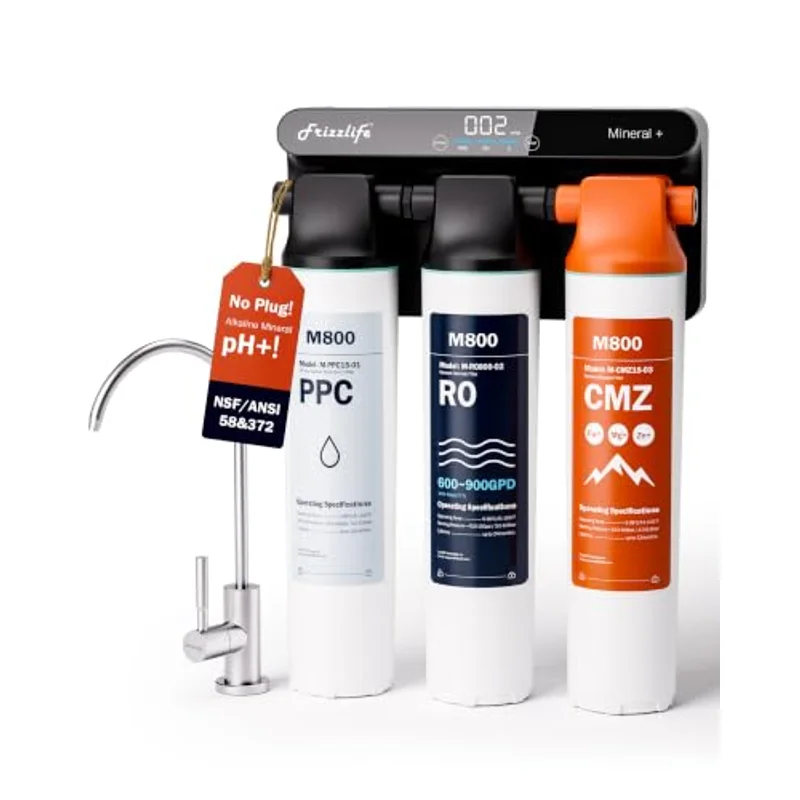
Frizzlife M800

Minerals back, with no storage tank and no outlet
NSF/ANSI 58 & 372 · up to 900 GPD · 4:1 pure-to-drain · non-electric · adds calcium, magnesium, zinc

Almost every tankless system needs a pump and therefore a plug. The M800 runs on existing line pressure instead, which makes it the answer for a cabinet with no power, and it posts the best efficiency here at 4:1 pure-to-drain. Its eight stages include a mineral addition of calcium, magnesium and zinc after the membrane, and the faucet shows live TDS and filter life — useful if you want to watch that stage work. Measure first: at 14.5 by 5.1 by 19.7 inches it's a tall box, and being non-electric it wants decent incoming pressure. We weigh the format choice in our tankless versus tank comparison.

The theme that repeats across owner reviews: no cord, no tank and no noise, and the water-waste ratio is the specification that decided it for them.

Frizzlife M800 non-electric tankless reverse osmosis system with alkaline mineral stage
$299.99
Non-electricCheck price →

Route three: it may already be in the box you rebuy every year

If you own a six-stage system with standard 10-inch housings, the alkaline cartridge isn't an upgrade decision at all — it's one of the parts in the annual replacement set.

05Consumable

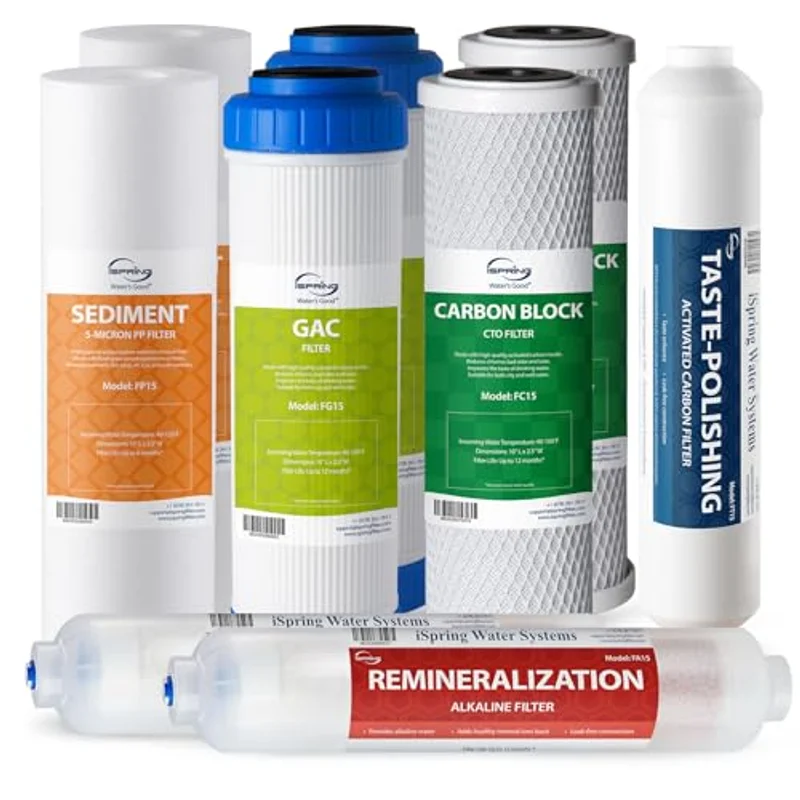
iSpring F9K, 1-year replacement set

If you own a 6-stage system, you're already buying this
9 cartridges · a full year · 2 alkaline stages included · standard 10 x 2.5 inch · no RO membrane

Nine individually wrapped cartridges: two sediment, two granular activated carbon, two carbon block, one post-carbon and two alkaline remineralization filters. That's a year of maintenance for a six-stage system, and the mineral stage is two of the nine parts. Read the last line of the specification before ordering: the RO membrane is not in this box. Membranes last two to three years and are bought separately — normally the right way around, but it catches people out. If you'd rather have it included, iSpring's F6K75 six-month pack at $87.69 carries a 75 GPD membrane with the alkaline filter.

iSpring F9K one-year reverse osmosis replacement filter set with alkaline remineralization cartridges
$69.24
1-year setCheck price →
At a glance

The mineral-stage options, side by side

Five ways to get calcium and magnesium back into RO water, from a $30 retrofit to a complete system. Prices move on Amazon — confirm the live price before buying.

OptionRouteMineral stageRated life or outputPrice
Waterdrop MNR35Retrofit any systemCa, Mg, Na, K9–12 months / 1,100 gal$29.99Price
iSpring RCC7AK-BNComplete systemNatural mineral AK stage75 GPD · NSF/ANSI 58$198.76Price
APEC ROES-PH75Complete systemCalcium remineralization75 GPD · WQA certified$239.99Price
Frizzlife M800Complete systemCa, Mg, Znup to 900 GPD · NSF/ANSI 58 & 372$299.99Price
iSpring F9K setYearly consumable2 alkaline cartridges of 91 year · no membrane$69.24Price

What a mineral stage costs to keep running

As a standalone cartridge. The MNR35 is $29.99, rated 9 to 12 months or 1,100 gallons, whichever comes first. On Waterdrop's recommended nine-month schedule that's $29.99 divided by 0.75 of a year, or $39.99 annually; stretched to twelve months it's $29.99. Call it $30 to $40 a year, or about $0.027 per gallon at the rated life. A household drawing two gallons a day uses 730 gallons a year, well inside the 1,100-gallon rating, so the calendar limit is the one you'll hit; a heavier household at four gallons a day hits the gallon rating at around nine months instead. Either way, budget one cartridge a year.

Inside a system. Here the mineral stage nearly disappears as a line item. The iSpring F9K year-set is $69.24 for nine cartridges, two of which are the alkaline stage — you were buying the sediment, carbon and post-carbon filters regardless, so the mineral capability rides along inside a bill you already had. APEC works differently, and it pays to know before you budget: its FILTER-SET-ES pre-filter set is $25.46 for six months and contains one sediment filter and two carbon blocks, with the calcium cartridge bought separately.

Where it sits in the yearly bill. Small. RO running costs are dominated by pre-filters two or three times a year and, every two to three years, the membrane. A mineral stage moves your annual number by tens of dollars, not hundreds, and it should not decide which system you buy. We break the full picture down model by model in our filter replacement cost guide, and set the yearly bill against bottled water and pitcher filters in are reverse osmosis systems worth it.

Who should skip a mineral stage, and who really shouldn't

Skip it if you want low dissolved solids on purpose. Reef and planted-aquarium keepers are the clearest case: the point of RO or RO/DI water in that hobby is a blank slate, remineralized afterwards to a controlled recipe the keeper chooses and measures. An uncontrolled mineral bed upstream of that is counterproductive — you're adding an unknown you then have to correct for.

Espresso is more nuanced than the internet suggests. Machine owners run RO water to keep scale out of a boiler, a real and expensive problem. But zero isn't the target either: water with essentially nothing dissolved in it extracts poorly and is unkind to metal components, which is why people who care about this blend RO water with a measured mineral concentrate to hit a recipe. An inline cartridge you can't dose or verify is the wrong instrument for that. The same logic covers a steam oven fed from the RO faucet, and anyone whose original complaint was hardness — adding minerals back moves in the direction you paid to move away from.

Now the people who should. The largest group by a distance: households who installed a system, drank the water, and quietly missed the taste of their own tap. That's not a nutritional complaint and it doesn't need to dress up as one — it's a thirty-dollar fix for something you notice several times a day. Close behind are people who were buying bottled mineral water for the taste and expected RO to replace it; without a mineral stage it doesn't. Then a group nobody talks about: people who install RO and then drink less water, because they don't enjoy it any more. If that's your kitchen, the mineral stage isn't a nicety — it's what makes the system you already paid for get used.

If you can't decide, the sequencing is easy: install without, live with the water for a month, add the cartridge afterwards if you miss it. It's a $29.99 experiment, not a fork in the road — and it's why we wouldn't pay a large premium for a system on the strength of its mineral stage alone. Cabinet space, drain ratio and the yearly cartridge bill shape ownership far more, and our main guide to the best reverse osmosis systems weighs those across six models.

How to judge this for yourself: the TDS meter, and its limits

A TDS pen is a cheap conductivity meter, and it's the one measurement in this article you can make yourself. Take three readings: your cold tap, the RO faucet, and — if you've fitted a mineral stage — the RO faucet again with that cartridge in line. The drop from the first to the second is the membrane working; a fall from a few hundred ppm to the low double digits is the normal picture. The rise to the third is your mineral cartridge dosing, and it should be a modest, consistent climb rather than a return toward tap levels. The Waterdrop G3P600 and Frizzlife M800 save you the errand by displaying live TDS on the faucet.

Now the part most people get wrong, and it matters more than the readings. TDS is one aggregate number derived from electrical conductivity. It tells you how much dissolved material is present and nothing about which. Three hundred ppm of calcium bicarbonate from a limestone aquifer and three hundred ppm that happens to include sodium, nitrate and a little arsenic read identically on the pen. A low number is not a certificate of safety; a high number is not evidence of danger. The meter is also blind to whole categories of things people buy RO for: PFAS are measured at parts per trillion, far below what a conductivity meter can resolve, and bacteria and cysts are not dissolved solids at all. That's why we lean on NSF/ANSI 58 rather than a pen reading — the certification means an independent body verified a specific reduction claim, whereas the pen means a needle moved.

Where the meter earns its place is trend, not truth. Log the RO reading every couple of months against a stable tap reading. When it starts creeping upward, the membrane is aging — a maintenance signal no calendar reminder can give you.

FAQ

Questions people actually ask

Does reverse osmosis remove all the minerals from water?

Not all, but most. Manufacturers publish a reduction percentage rather than total removal: iSpring rates the RCC7AK-BN at 93% to 98% TDS reduction, and its 75 GPD membranes at up to 97% under NSF/ANSI 58 test conditions. A supply arriving at 250 ppm therefore typically leaves the faucet somewhere in the single digits to the low twenties rather than at zero. What remains is a trace of whatever was in the water to begin with.

Is reverse osmosis water bad for you?

That is not a question a buying guide should answer as if it were a health authority, and we won't. What we can offer is the practical framing: drinking water is a minor contributor to mineral intake compared with food for most people on an ordinary diet, the flat taste is the complaint owners actually report after an install, and a remineralization stage costs about $30 if you want the minerals and the flavor back. Anything specific to your own health belongs with your doctor rather than with us.

Can I add a remineralization filter to any RO system?

In practice, yes for almost any under-sink system. The Waterdrop MNR35 is built for 1/4-inch and 3/8-inch quick-connect tubing, which is what nearly every under-sink RO system sold in the US uses, and it fits inline between the final stage and the faucet regardless of brand. The exceptions are sealed countertop units, where you cannot reach the internal plumbing, and hot-water lines, which Waterdrop explicitly says not to connect it to.

Will a mineral filter raise my TDS reading, and is that a problem?

Yes it will, and no it is not. The cartridge works by dissolving mineral into the water, so the meter climbs — that rise is the cartridge doing its job, and a stable rise is how you confirm it is still dosing. What matters is knowing which reading you are taking. A measurement at the faucet downstream of the mineral stage reflects purified water plus added mineral, not membrane performance. To judge the membrane itself you need a reading taken before the mineral stage.

Keep reading

Next, the parts that cost money